Webinar 09:00 AM CST
Professional Development Hours
This webinar counts for 1 Professional Development Hour. Certificates will be provided after the presentation.
About the presenter:

Webinar 09:00 AM CST
Professional Development Hours
This webinar counts for 1 Professional Development Hour. Certificates will be provided after the presentation.
About the presenter:

Online event 12:00 PM CST
The Women in Industry Subcommittee (WIND) of the Society for Underwater Technology in the US (SUT-US) is pleased to invite you to the Champagne and Conversation Series Edition 8 – Table Discussions. We are excited to continue providing a discussion platform for Women in Industry to address important topics focused on diversity, leadership and career development.
The event will be held at the Memorial Wine Cellar from 6pm-8pm (CDT). Seating is limited to 30 people, we encourage you to reserve your seat in advance.
Table Leads and Topics:
Webinar 0900 CST
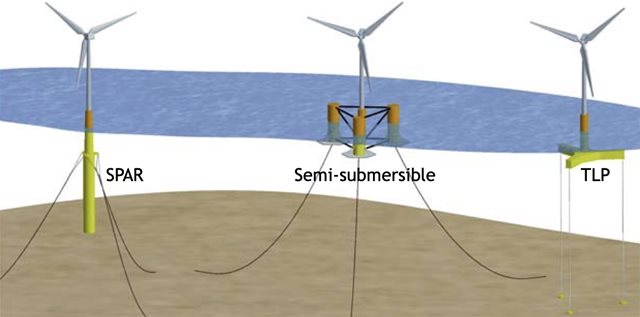
Floating Wind is a hot topic in the renewable energy industry. Do you know the differences among floater types such as Semi, Spar, and TLP? What are their pros and cons? Do you want to learn how they are moored/anchored in the middle of an ocean? This technical presentation will give you all the important knowledge about Floating Offshore Wind Turbines (FOWT) and their mooring systems.
We have invited Professor KT Ma of National Taiwan University to give us a talk. Don’t miss this great learning opportunity!
Professional Development Hours
This webinar counts for 1 Professional Development Hour. Certificates will be provided after the presentation.
About the Presenter
Kai-Tung (KT) Ma, Professor, Ocean Engineering, National Taiwan University
KT started his academic career recently as a full-time professor at National Taiwan University. Before that, he was a Team Lead at Chevron Energy Technology Company in charge of mooring and geotechnical engineering for their floating systems around the world. Accumulated 30 years of experience, he has worked for different organizations including consulting firms and class societies. He had experience working at American Bureau of Shipping (ABS) as a senior engineer in the R&D department. Throughout his career, he has published 35+ papers and 4 patents in the areas of mooring engineering and reliability of marine structures. KT served in API and ISO committees, as a chair and co-chair respectively, developing codes and standards related to station-keeping of offshore structures. Because of his contributions to the industry, he was elevated to the grade of Fellow by Society of Naval Architects and Marine Engineers (SNAME). He has written a textbook “Mooring System Engineering for Offshore Structures”, which was published by Elsevier in 2019. KT earned his BS degree in naval architecture from National Taiwan University, and MS and PhD degrees in naval architecture and offshore engineering from the University of California at Berkeley.
In 2020, The Marine Alliance for Science and Technology for Scotland (MASTS) welcomed over 500 attendees from 28 countries to its online Annual Science Meeting, and we can’t wait for you to join us again as we celebrate our 11th annual conference online. Featured sessions with live Q&A include talks on Global Seagrass Projects, Aquaculture as a critical pathway to future Net Zero food production in Scotland, fisheries science, multiple marine stressors, and marine social sciences. Plus, many general science sessions amongst global plenary talks and ePosters throughout the event.
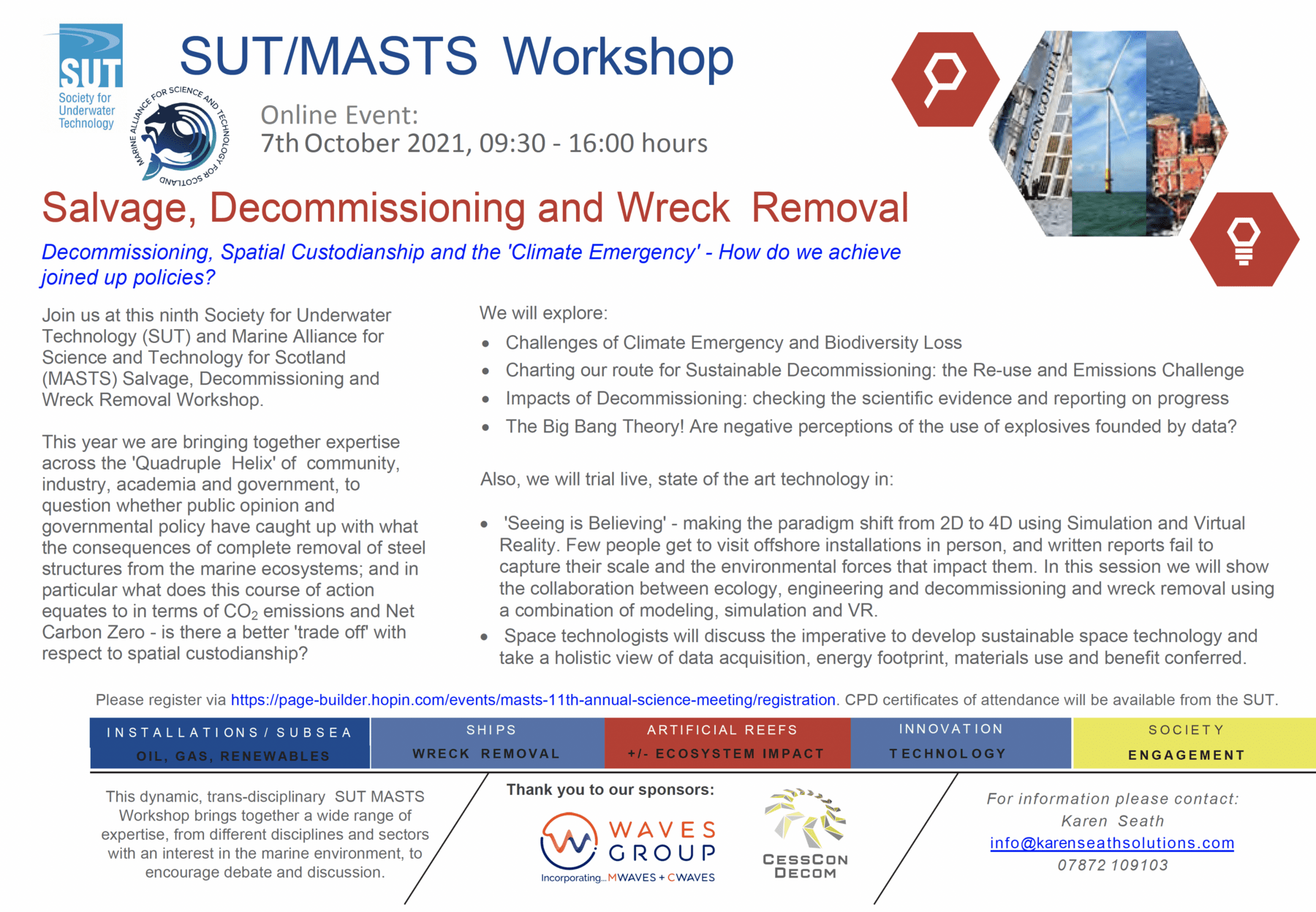
Featured Society for Underwater Technology’s workshop – Decommissioning, Spatial Custodianship and Climate Emergency – How do we achieve joined-up policies? An open to all workshop with live Q&A with speakers, 7th October 2021.
This cross-disciplinary meeting brings together members of the global marine science community as the UK’s largest marine science focussed conference, with the aim of promoting and communicating research excellence and forging new scientific collaborations.
Full programme and registration here
MASTS also looks forward to co-hosting with the SUT, their annual “Decommissioning & Wreck Removal workshop. This online workshop will be open to all, taking place on the afternoon of 7th & morning of 8th October 2021.
Dalian, China
Ocean mineral and hydrocarbon deposits are major resources to ensure sustainable industrial development in the future. In order to provide an open platform for the advancement of global marine resources exploration and development technology, the 10th International SUT (China) Technical Conference will be held in Dalian, China, from October 22 to 25, 2021. We would like to extend our warmest invitation to experts and scholars from home and abroad engaged in scientific research, education, production, application, and other disciplines to discuss the development of underwater technology, engineering equipment, and related industrial topics.
Organisations:
SUT 中国分会 SUT China Branch
大连理工大学 Dalian University of Technology
中国石油大学(北京)China University of Petroleum (Beijing)
辽宁省力学学会 Liaoning Society of Theoretical and Applied Mechanics
大连市科学技术协会 Dalian Association for Science and Technology
工业装备结构分析国家重点实验室 State Key Laboratory of Structural Analysis for Industrial Equipment
海岸和近海工程国家重点实验室 State Key Laboratory of Coastal and Offshore Engineering
橡塑制品成型数值模拟与优化学科创新引智基地 Subject Innovation and Talent Recruitment Base of Numerical Simulation and Optimization in the Forming Engineering of Rubber and Plastic Products
大连理工大学宁波研究院 Ningbo Institute of Dalian University of Technology
Deadlines:
Abstract submission: 15 August 2021
Full paper submission: 15 September 2021
Registration: Please click here to register: http://sut2021.aconf.cn/register.h
(Conference fees apply)
Contacts:
Gu Qingmei 顾庆梅 +86 13717911000 [email protected]
Du Hongze 杜洪泽 +86 17824830063 [email protected]
Organising Committee:
Chairman: Frank Lim, Chair SUT Branch
Executive Chairman:Yan Jun 阎军
Are you a young professional looking to make connections and kickstart your career? Want to keep up with the pace of your industry and job market? Come to the SUT YES! Networking Skills night and learn some tips and tricks of the trade on how to network, build connections and further your career.
Programme
5:30pm – Registration / drinks / food
6:00pm – Event starts
8:30pm Event end (approx.)
Thank you to our event sponsors:
The Offshore Site Investigation and Geotechnics Committee (OSIG) of the Society for Underwater Technology in the US (SUT-US) is pleased to invite you to a webinar session titled “Sediment Mobility, Scour and Seabed Disturbance Consideration for Offshore Wind Development” delivered by industry and academia experts.
Registration:
SUT Members: $100
SUT Non-Members $125
SUT Student Members: Free
SUT Student Non-Members: $15
Student registrations are only valid using ‘.edu’ or corresponding institutional email domains. Connections are unique and should only be used by one person. Duplicate connection will be forced out of the webinar session by the organizers.
Professional Development Hour Cerficates:
2.5 PDH certicates will be issued a day after the presentation. If you have more than one person viewing these webinars at your location, you can request additional PDH certificates for $10 at the email above.
Webinar Session Program
| 8:00AM CDT | Welcome & Introduction Tricia Hill, Society for Underwater Technology in the US (SUT-US); Dr. Xiaoyan Long, Fugro |
| 8:10AM CDT | Sediments on the move? Understanding the local geology and geomorphodynamics of the US Atlantic coast and continental shelf for offshore wind development Dr. Nina Stark, Virginia TechLocal seabed geology and geomorphology are key factors for the site assessment and design of offshore wind developments. Both can vary on large or small spatial scales calling for smart designs of site investigation strategy as well as later design of foundations and cable routes. However, special attention should also be given to temporal variations of geomorphodynamics in terms of sediment erosion, deposition, and migration which may change the landscape of an area significantly over time. Particularly climate change including sea level rise, change of storm patterns, intensity, and frequency, may introduce additional uncertainties and importance regarding active geomorphodynamics in areas of interest. This presentation provides an overview of local geology and geomorphology of the US Atlantic continental shelf and relevant geomorphodynamic processes affecting offshore wind development. |
| 8:30AM CDT | Overview of Block Island Windfarm’s Cable Shore Crossing Incidents and Solutions to Preventing them in the Future Mr. David McLaurin, Intecsea Engineering/AdvisianNational Grid’s portion of Block Island Wind Farm’s power transmission export cable (from The substation at Block Island to the mainland) has been experiencing issues since it was installed in 2016. While there have been no problems with the cable’s landing point on the mainland, in Narragansett, where a horizontal directional drill (HDD) was performed at the shore crossing to bury it deep below the beach area, it’s been a different story on the Block Island side. At Block Island, a less expensive, shallower jet plow method was used to cross the shoreline. The shore crossing location at Block Island ended up more rocky than expected and burial depths for the cable were not sufficient to avoid exposure of the cable at multiple locations. With time, exposed sections of this cable have been exacerbated. In recent months, National Grid started preparing to install the new stretch of cable through its HDD pipe at Block island, when workers discovered unexpected obstructions. They are working with contractors to clear the blockages, but have decided to halt installation until a solution if found regarding the sand, mud and other obstructions on the seabed. On the other side, Orstead’s inter-array cable (from the wind turbines to the Substation at Block Island) also had similar issues at the shore crossing location on Block island. Recently, Orstead corrected these issues with an HDD and a new cable was installed and spliced into the rest of the system. Seabed scour is widely recognized as a difficult engineering problem which is likely to cause instability of buried cables at the shore crossing. This discussion will address the conditions and design issues that caused these incidents with the goal of preventing similar issues on future projects in offshore wind in the NE USA. This includes discussion on scour, other causes for unburial, prevention, and mitigations. |
| 8:50AM CDT | Scour Mitigation at Offshore Wind Foundations Dr. John Harris, HR Wallingford, UKThere are a range of approaches that can be taken to prevent or mitigate against scour around foundations, either planned for or as a remedial measure if scour is more severe than was expected. Rock armour has been the most commonly used form of scour protection at offshore wind farms using gravel, quarry run stone or blasted rock to cover a particular area of seabed to a specified thickness. In addition, other approaches include monitoring of the seabed around foundations, with the design philosophy for the monopile foundations involving installing them without scour protection. The presentation will provide an overview of scour protection measures, outlining the principle approaches in common use including examples from built wind farms. It will also look at the approaches adopted in a range of seabed soil conditions as well as the effects that can be induced by the placement of scour protection measures including secondary scour. The talk will also touch upon recently discussed issues of cable damage over the placed scour protection. |
| 9:10AM CDT | Break |
| 9:20AM CDT | Scour Hazard and Implication for Renewable Foundations and Cables Dr. Joe Tom, University of Illinois Urbana-ChampaignScour is a nearly ubiquitous risk for offshore renewable energy infrastructure, particularly in the relatively shallow waters where most current developments exist. Local scour is the process in which the seabed is transported away from a structure (e.g., the foundation or seabed cables) due to moving water, such as induced by waves and currents. Unless prevented through scour protection, sediment loss caused by scour around foundations can lead not only to reductions in foundation capacity and system stability but also changes in the structural dynamics of wind energy systems, affecting energy harvesting uptime and production. Although many export cables tend to be buried, scour presents complicated risks for unburied cables. These risks include the potential for vortex-induced vibrations and cable fatigue associated with free-span development as well as changes in the burial conditions that can lead to inefficiency in cable thermal design and management. In this presentation, we will first briefly visit the primary mechanics that lead to local scour (a complex interplay between fluid mechanics and soil mechanics) around foundations and cables. This will then lead us to an overview of the impact of scour on monopile foundations in particular. Finally, we will discuss learnings from the oil and gas industry on sediment transport effects for unburied cables and the potential implications of this for renewable energy. |
| 9:50AM CDT | TBC Dr. Sarah Courbis, Advisian |
| 10:10AM CDT | Panel Q&A Session Dr. Xiaoyan Long, Fugro |
| 10:30AM CDT | Closing Remarks Andrew Hill, BP |
Tuesday 27th July 2021 at 1200hrs GST (0900hrs BST)
Baker Hughes will investigate the use of Thermoplastic Pipes (RTP) pipe to bring new life to aging and/or damaged pipes at a fraction of the installation cost.
Strohm will examine the use of Thermoplastic Composite Pipe (TCP) for CAPEX and OPEX reduction. TCP enables competitive solutions, not only for the oil & gas sector but also in the Energy Transition: from decarbonization to CCUS and H2 applications.
This webinar is free to attend but booking is essential.
Sponsored by Baker Hughes and Subsea 7

SUT is delivering a 15-hour (over 5 days) foundation-level virtual Subsea Awareness Course presented by leading industry figures based on its highly successful face-to-face 5-day course which has seen over a thousand delegates benefit over more than 20 years.
20-24 September 2021 – Interactive Sessions will run from 10:00hrs – 13:00hrs BST (UTC+1)
The virtual SAC is aimed at new entrants who are already technically qualified but just entering the offshore energy industry and/or the subsea sector; technically qualified experienced personnel undergoing a technology transfer and conversion process into the subsea sector; and non-technical personnel from legal or finance sectors who regularly deal with the subsea sector.
Sessions will cover:
Cost (excluding VAT where chargeable)
Attendees of previous SUT Subsea Awareness Courses said:
“A great course from which to gain a thorough understanding of the existing technologies that can help solve current problems”
“Extremely helpful and definitely recommended for people of all disciplines”
“The presenters were excellent, and the course material was at a very professional level”
“Great course and great instructors”
“Well organised and the presenters made learning about subsea enjoyable”
“This course increased subsea vision and understanding”
“It helped me improve and consolidate my existing knowledge”
Registration for this event has now closed.
Programme:
12:00 – Session Starts –House keeping
12:05 – Introduction by chair Raffaele Ragni, NGI
12:10 – Presentation by Marc Stapelfeldt
12:40 – QA/Panel Discussion
13:00 – Session Ends
View the Post Event Report HERE